
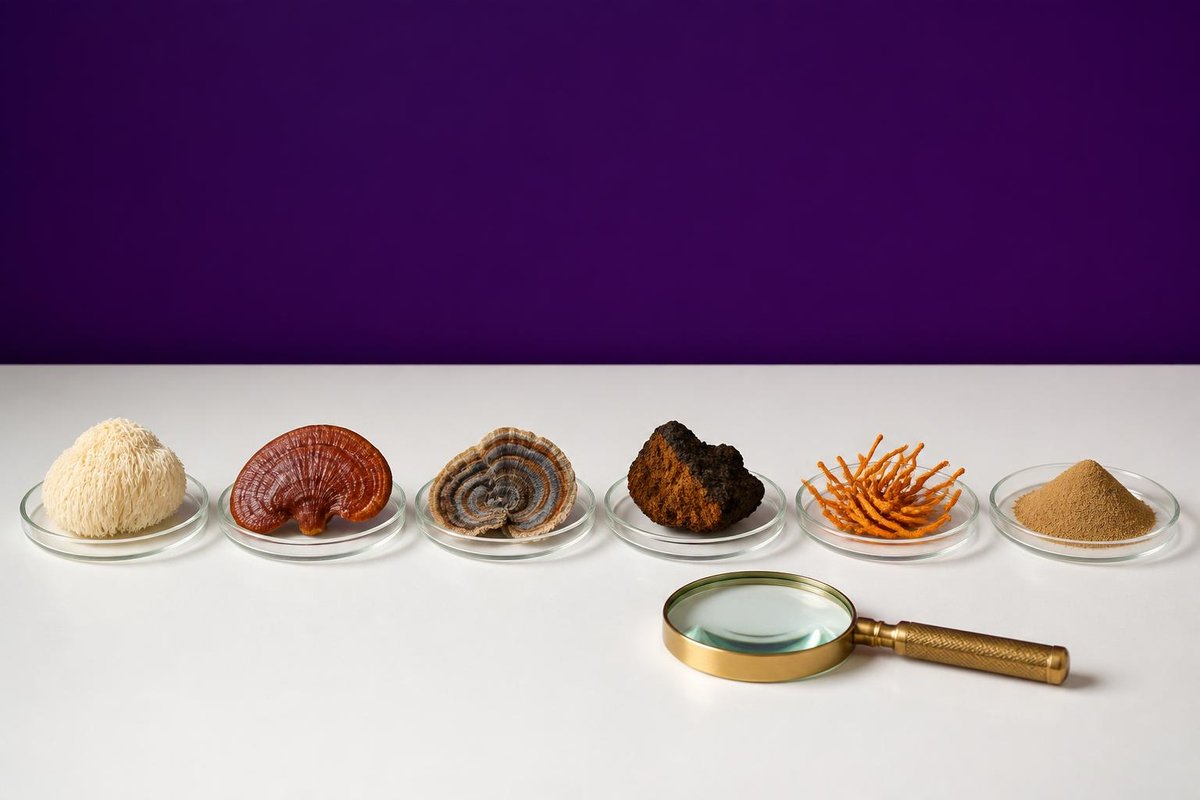
What Makes a Mushroom Supplement Medical Grade? The MushroomMD Standard
Quick answer: A mushroom supplement is medical grade when it passes six checks. It names the exact species (Identity), says which part of the mushroom it uses (Source), discloses how it was extracted (Extraction), measures its active compounds (Potency), proves it was tested for contaminants (Purity), and gives a serving that matches what human studies used (Dose). We call this the MushroomMD Medical Grade Standard.
Why "Medical Grade" Needs a Definition
Walk down any supplement aisle and you will see mushrooms everywhere: lion's mane for focus, reishi for sleep, turkey tail for immune support. Many of these labels look alike. Very few tell you enough to know whether the product inside resembles anything that was studied in people.
That matters most if you are managing a real health concern, or if you are a clinician deciding what to recommend. A patient with memory worries and a patient buying a trendy mushroom coffee deserve different levels of confidence.
There is no legal definition of "medical grade" for supplements. Mushroom supplements are sold as dietary supplements in the US. Manufacturers must follow good manufacturing practices, including checking the identity of their ingredients (21 CFR Part 111), but nothing requires the label to show how much of the active compounds a product contains, or which part of the fungus went into it.
So we wrote our own standard. In this guide you will learn the six checks, what each one looks like on a real label, and how to use them together.
Key Takeaways
- A medical grade mushroom product passes six checks: Identity, Source, Extraction, Potency, Purity and Dose.
- "Mushroom" on a label can mean the fruiting body or mycelium grown on grain. The two can be very different products.
- Potency means measured active compounds per serving, not "1,000 mg of mushroom."
- A certificate of analysis from a third-party lab is the minimum proof of purity.
- A dose only counts as "clinical" if it matches what the human studies actually used.
The 6 Checks at a Glance
| Check | The question it answers | A product fails if |
|---|---|---|
| Identity | Is this really the species on the label? | It lists only a common name or "mushroom blend" |
| Source | Which part of the fungus is in the capsule? | It hides whether it is fruiting body or mycelium on grain |
| Extraction | How were the compounds pulled out? | It gives no method or ratio |
| Potency | How much of the active compounds is in a serving? | It lists weight of "mushroom" but no measured actives |
| Purity | Was it tested for contaminants? | It cannot show a third-party certificate of analysis |
| Dose | Does a serving match the research? | The serving is far below what human studies used |
Check 1: Identity
The product names the species by its Latin name, such as Hericium erinaceus for lion's mane or Trametes versicolor for turkey tail. The best products also name the strain.
Once a mushroom is dried and powdered, you cannot tell species apart by looking. Researchers have used DNA barcoding to check the identity of powdered mushroom products for exactly this reason (Raja et al., 2017). Common names are loose, too. "Reishi" can refer to more than one Ganoderma species.
Look for: A Latin name on the label, and ideally a note that identity was confirmed by testing.
Species matters just as much with psilocybin mushrooms. More than 200 species contain psilocybin, and they vary in potency and in their mix of tryptamine and beta-carboline alkaloids. "Psilocybin mushroom" or "magic mushroom" alone can't tell you what psychoactive or therapeutic effects to expect. The species can.
Check 2: Source
The label says whether the product is made from the fruiting body (the mushroom itself) or from mycelium (the root-like network), and what the mycelium was grown on.
Much of the mushroom supplement market is mycelium grown on grain such as oats or rice. When that whole mix is dried and ground, the grain comes with it. Lab methods now separate beta-glucans (a key group of active compounds) from starch, which is how testers can show when a product is mostly grain (McCleary and Draga, 2016).
Look for: "Fruiting body" or "mycelium" stated plainly. If it is mycelium, look for how the grain content is handled or measured.
Is mycelium always a bad sign?
No. Some well-studied extracts come from mycelium grown in controlled liquid culture. AHCC, a shiitake mycelium extract, is one example. The real problem is a label that does not tell you what you are getting.
Check 3: Extraction
The label discloses how the product was extracted (hot water, alcohol or both) and the extraction ratio.
Different compounds dissolve in different solvents. Water extraction pulls out beta-glucans. Alcohol extraction pulls out compounds such as the triterpenes in reishi. A dual extract uses both. Raw, unextracted powder may leave much of the active material locked inside the mushroom's tough cell walls, which are made largely of chitin.
Look for: The method named on the label, and a ratio such as 8:1, meaning 8 parts raw mushroom went into 1 part extract.
Check 4: Potency
The product states the measured amount of its active compounds per serving. For most species that means beta-glucans. For some it means species-specific compounds, such as triterpenes in reishi or cordycepin in Cordyceps militaris.
"1,000 mg of lion's mane" tells you the weight of the powder, not how much of anything useful is in it. Two products with the same milligrams can differ many times over in actual content.
Look for: A number and a unit, such as "beta-glucans: 25% by weight," tested by a named method. Be cautious with "polysaccharides," a broader measurement that can include starch.
Can two products with the same milligrams really differ that much?
Yes. A capsule of fruiting-body extract tested for beta-glucans and a capsule of mycelium-on-grain powder can both say 500 mg. Only one of them is telling you what is inside.
Check 5: Purity
Every batch is tested by an independent lab for heavy metals, microbes and pesticides, and the product can show you the certificate of analysis (CoA).
Mushrooms are natural accumulators. Their fruiting bodies can take up heavy metals such as cadmium, lead and mercury from where they grow, and levels vary by species and location (Kalač and Svoboda, 2000). Cultivated mushrooms grown on controlled substrates tend to have lower levels than wild ones, but testing is still the only way to know.
Look for: A CoA from a third-party lab that names the lab, the batch number, the test methods and the results against limits. Our guide to reading one is coming soon.
Check 6: Dose
The serving size matches the amount, preparation and duration used in human research for the reason you are taking it.
Research doses are often much larger than a typical capsule. In one double-blind trial of lion's mane in older adults with mild cognitive impairment, participants took four 250 mg tablets three times a day, about 3 grams daily of 96% lion's mane powder, for 16 weeks (Mori et al., 2009). Their cognitive scores improved compared with placebo and slipped again after they stopped. A product offering 500 mg a day of a different preparation is not a match, even if the label says "clinically studied."
Look for: A serving you can compare to a named study, with the same part of the mushroom and a similar preparation.
You may have to take more than the recommended dose on the package to see clinically significant changes in your health. Make sure to check for potential drug interactions and talk with your doctor before starting any new supplement, including mushrooms.
How to Use the Standard
If you are a patient, bring the six checks to your next conversation with your doctor. A product that passes all six is one your clinician can evaluate. A product that fails Identity or Purity is one to put back on the shelf.
If you are a clinician, treat the Standard as a quick screen before you recommend a product. Identity and Purity protect your patient. Source, Extraction and Potency tell you whether the product resembles the research. Dose tells you whether it can reasonably be expected to work the way the studies suggest.
A product does not need to be expensive to pass. It needs to be transparent.
What the Standard Is Not
The MushroomMD Medical Grade Standard is a way to judge product quality and transparency. It is not a government certification, and it does not mean a product will treat or cure any condition. Passing all six checks means a product is honest about what it is. Whether it is right for you is a conversation for you and your healthcare provider.
Frequently Asked Questions
Is "medical grade" a regulated term for mushroom supplements?
No. There is no legal definition of "medical grade" for dietary supplements in the US. That is why MushroomMD publishes its own Medical Grade Standard: six checks (Identity, Source, Extraction, Potency, Purity and Dose) that anyone can apply to a label. When we use the term, it means a product passes all six, not that a government agency has certified it.
How can I tell if my mushroom supplement is mostly grain?
Check the label for "fruiting body" or "mycelium." If it says mycelium, or does not say at all, look for a beta-glucan percentage tested by a named method. Mycelium grown on grain can carry a lot of starch into the final powder. A product that reports only "polysaccharides," or no actives at all, gives you no way to know.
Why does the MushroomMD Standard put Dose last?
Because dose only means something once the other five checks pass. A serving that matches a clinical study is meaningless if the product is the wrong species, mostly grain, unextracted, unmeasured or contaminated. The Standard works in order: first confirm what the product is, then confirm there is enough of it.
Do I need all six checks, or is a certificate of analysis enough?
A certificate of analysis covers Purity and, when it reports actives, part of Potency. It does not tell you the source, the extraction method or whether the serving matches the research. The MushroomMD Standard asks for all six because a clean product can still be the wrong preparation at the wrong dose.
Can I use the Standard to compare products I already own?
Yes. Take the label and any certificate of analysis, and go through the six checks in order. Most people find their products pass one or two, usually Identity. Write down where each one falls short, then bring that list to your healthcare provider when you talk about what to keep taking.
Where should I start if I'm new to medicinal mushrooms?
Start with the species that has the evidence for your specific goal, then use the Standard to choose a product. Our clinical monographs summarize the human research for each species, including the doses studied. Read the monograph first, then hold any product you are considering up against all six checks.
This content is for educational purposes only and is not a substitute for professional medical advice, diagnosis or treatment. Statements on this website have not been evaluated by the Food and Drug Administration. Always consult a qualified healthcare provider before starting, stopping, or changing any medication, nutrition, supplement, or lifestyle program.
References
- US Code of Federal Regulations. 21 CFR Part 111: Current Good Manufacturing Practice in Manufacturing, Packaging, Labeling, or Holding Operations for Dietary Supplements.
- Raja HA, et al. DNA barcoding for identification of consumer-relevant mushrooms: A partial solution for product certification? Food Chemistry. 2017.
- McCleary BV, Draga A. Measurement of β-Glucan in Mushrooms and Mycelial Products. Journal of AOAC International. 2016;99(2):364-373.
- Kalač P, Svoboda L. A review of trace element concentrations in edible mushrooms. Food Chemistry. 2000;69(3):273-281.
- Mori K, et al. Improving effects of the mushroom Yamabushitake (Hericium erinaceus) on mild cognitive impairment: a double-blind placebo-controlled clinical trial. Phytotherapy Research. 2009;23(3):367-372.

Help us make MushroomMD better
Was this article helpful?
Thank you for your feedback. It helps us keep MushroomMD accurate and useful.